



Fix the most dangerous vulnerabilities first
Intravex VM scores every vulnerability by real exploit likelihood, severity and how critical the host is. It shows what to patch first, applies the fix as a signed command and confirms the result with the next scan.
| CVE | Package | KEV | EPSS | Priority | Status |
|---|---|---|---|---|---|
| CVE-2021-44228 | log4j-core 2.14.1 | KEV | 97% | 98 | Open |
| CVE-2024-6387 | openssh 8.9p1 | — | 41% | 84 | Open |
| CVE-2023-4863 | libwebp 1.3.1 | KEV | 88% | 79 | Open |
| CVE-2023-44487 | nginx 1.22.1 | KEV | 79% | 66 | Open |
| CVE-2022-22965 | spring-beans 5.3.17 | KEV | 97% | 61 | Open |
| CVE-2023-38545 | curl 8.3.0 | — | 12% | 38 | Open |
Sample data. Names and numbers are made up.
Capabilities
Explainable priority
A 0–100 score from CISA KEV, EPSS, CVSS, exposure and host criticality, with the reason behind each score. SLA and exceptions included.
Patch management
Missing updates, deployments, patch plans and policy. OS, application, driver and BIOS updates, with rollback.
Fix confirmed by scan
A fix runs as a signed command. When the next scan no longer finds the vulnerability, it moves to "Fixed, verified by scan".
Zero-day and mitigation
When no patch exists yet, check the exploit conditions and apply a mitigation. Newly exploited vulnerabilities raise an alert.
Agentless scans and network devices
Hosts that cannot run an agent are scanned over SSH and WinRM. Routers, switches and firewalls are checked over SNMP v2c/v3 and SSH.
Misconfiguration and exposure
Open ports, certificates, web server configuration, services without authentication, SMB signing and risky software.
How it works
- 1
Find
The agent sends an SBOM; the server checks it against the offline database.
- 2
Rank
Ranking by KEV, EPSS, severity and host criticality.
- 3
Fix
Update, configuration fix, removal or mitigation.
- 4
Confirm
The next scan confirms the vulnerability is closed.
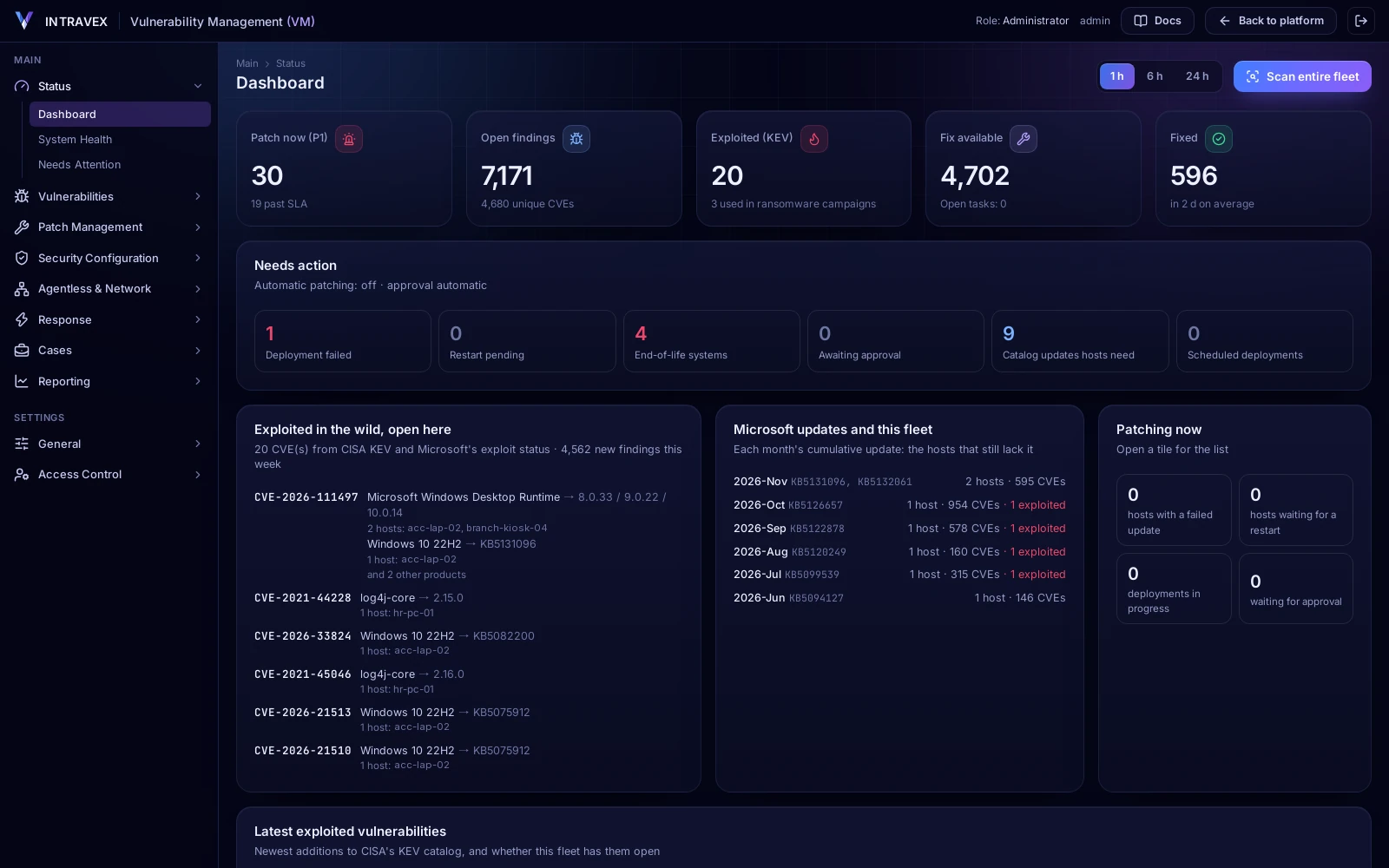
Inside the console
Specifications
| Agent | Intravex VM agent: Windows (MSI), Linux (deb, rpm: Debian, Ubuntu, RHEL family), macOS 12+ (pkg) |
|---|---|
| Agentless | SSH (Linux), WinRM (Windows), SNMP v2c/v3 and SSH (network devices) |
| Sources | Built-in SBOM cataloguer, Grype (offline database), CISA KEV, EPSS, Microsoft MSRC |
| Remediation guidance | An external LLM, a local Ollama model, or a template with no model |
| Reports | Vulnerability management, Patch status, Patch compliance, Deployments, System health, Risky software, Network exposure |
Frequently asked questions
Does it need internet access?
No. The CVE database ships with the server and works offline. You bring updates in under your own control.
How are servers without an agent checked?
They are scanned without an agent over SSH or WinRM. Network devices are checked over SNMP and SSH.
Does Intravex install patches itself?
If you want it to. Every update is a signed command and can require a second administrator's approval on critical hosts.
Try Intravex in your own environment
After a 30-minute demo we set up a pilot on your infrastructure together.